
CTFX Forex Help & Guides, CTFX Forex Tips & Tricks
Day Trading Strategies for South Africa

Jul
Day trading in South Africa and Botswana is growing fast, with more locals sharpening their skills in search of a financial edge. Here is the wild bit. Traders who consistently practice systematic learning and adapt their strategies can improve their performance by up to 10.3 percent. You might think the hardest part is reading the charts, but it is actually staying ahead of the game and knowing how to manage risk that sets the real winners apart.
Table of Contents
- Choosing The Best Day Trading Strategies
- Managing Risks In Southern African Markets
- Essential Tools And Platforms For Local Traders
- Tips To Succeed With Day Trading Strategies
Quick Summary
| Takeaway | Explanation |
| Robust Technical Analysis is Essential | Successful day trading relies on a multifaceted technical analysis strategy that incorporates key indicators such as Moving Averages, RSI, and Bollinger Bands to identify market trends and conditions. |
| Implement Advanced Algorithms | Traders should utilize machine learning and automated trading systems to enhance decision-making and adapt strategies to changing market conditions for improved profitability. |
| Effective Risk Management Strategies | Combining strict stop-loss parameters, diversification, and ongoing analysis is crucial in managing risks and potential losses, particularly in the volatile Southern African markets. |
| Select Suitable Trading Platforms | Traders must prioritize platforms that offer features like execution speed, real-time market data, and regulatory compliance to optimize trading efficiency and security. |
| Commit to Continuous Learning | Success in day trading requires ongoing education and improvement by attending workshops, networking, and utilizing trading journals to refine techniques and strategies. |
Choosing the Best Day Trading Strategies
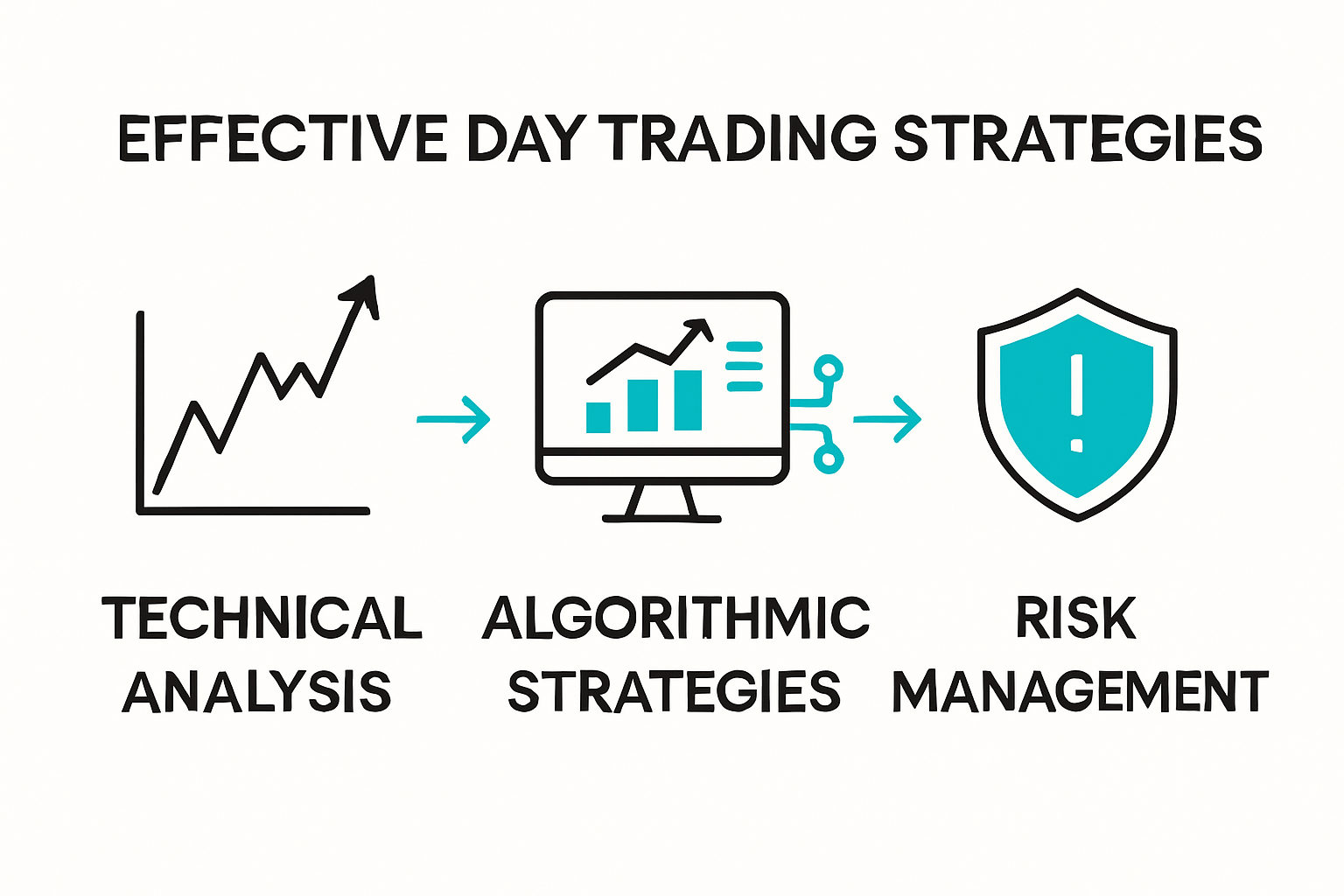
Successful day trading requires a strategic approach that balances risk management, market understanding, and technical analysis. Traders in South Africa and Botswana face unique market conditions that demand carefully selected strategies tailored to local financial landscapes.
Technical Analysis Foundations
Day trading strategies begin with robust technical analysis. Research from the University of Pretoria revealed that while technical analysis can outperform traditional buy-and-hold approaches, no single indicator works consistently across all investment horizons. This finding underscores the importance of developing a multifaceted strategy.
Key technical indicators traders should consider include:
- Moving Averages: Track price trends and potential momentum shifts
- Relative Strength Index (RSI): Measure market momentum and potential overbought or oversold conditions
- Bollinger Bands: Assess market volatility and potential price breakouts
To assist traders in comparing key technical indicators and their primary uses as mentioned above, the following table provides a concise overview:
| Indicator | Primary Use | Measures |
| Moving Averages | Tracking price trends and momentum shifts | Average price over time |
| Relative Strength Index (RSI) | Measuring market momentum and overbought/oversold conditions | Speed and change of price movements |
| Bollinger Bands | Assessing market volatility and price breakouts | Price volatility versus moving average |
Algorithmic Strategy Optimization
A groundbreaking study from Stellenbosch University demonstrated the potential of advanced computational techniques in day trading. Their research on reinforcement learning agents showed how artificial intelligence can improve decision-making processes, potentially reducing risk and enhancing profitability.
Traders can leverage these insights by:
- Implementing machine learning algorithms to analyze historical market data
- Using automated trading systems that adapt to changing market conditions
- Developing strategies that incorporate real-time data processing
Risk Management Techniques
Research published by the University of Cape Town highlighted the critical importance of transaction cost management in day trading strategies. The study found that high-frequency intraday strategies could achieve statistical arbitrage, but only when carefully managing trading expenses.
Effective risk management involves:
- Setting strict stop-loss parameters
- Diversifying trading positions
- Maintaining a disciplined approach to position sizing
- Continuously monitoring and adjusting trading strategies
Successful day trading is not about finding a single perfect strategy but developing a flexible approach that adapts to market dynamics. Traders must combine technical analysis, computational insights, and robust risk management to navigate the complex financial landscapes of South Africa and Botswana.
Remember that consistent learning, practice, and emotional discipline are just as crucial as the strategies themselves. No trading approach guarantees success, but a well-researched, methodical approach can significantly improve your odds of achieving profitable trades.

Managing Risks in Southern African Markets
Navigating the complex financial terrain of Southern African markets demands a comprehensive and strategic approach to risk management. Traders in South Africa and Botswana must develop sophisticated techniques to protect their investments and maintain sustainable trading performance.
Understanding Market Volatility
Investec research highlights the critical importance of position sizing as a fundamental risk management strategy. By allocating a specific portion of the trading portfolio to each trade, investors can limit the potential impact of individual trading decisions on their overall account balance.
Market volatility in Southern African markets presents unique challenges. Factors such as economic policy changes, commodity price fluctuations, and regional political dynamics can create rapid and unpredictable market movements. Traders must develop adaptive strategies that account for these complex variables.
Strategic Diversification Approaches
According to research from TechCabal, diversification across different asset classes and markets is an essential risk management technique. This approach helps traders reduce exposure to volatility in any single market segment.
Effective diversification strategies include:
- Asset Class Diversification: Spreading investments across stocks, bonds, commodities, and cryptocurrencies
- Geographical Diversification: Trading in multiple regional markets to minimize localized risk
- Sector Diversification: Investing across different industry sectors to balance potential market fluctuations
The table below organizes the main diversification approaches and the benefits mentioned in the content:
| Diversification Approach | Description | Risk Reduction Benefit |
| Asset Class Diversification | Spread investments across stocks, bonds, commodities, cryptocurrencies | Reduces exposure to one asset class’s volatility |
| Geographical Diversification | Trade across multiple regional markets | Minimizes risk from localised market events or policy changes |
| Sector Diversification | Invest across various industry sectors | Balances fluctuations affecting single sectors |
Advanced Risk Mitigation Techniques
Business Tech research emphasizes the critical role of stop-loss orders in managing trading risks. These automated mechanisms help traders minimize potential losses by automatically closing a trade when the price reaches a predetermined level.
Additional risk mitigation techniques include:
- Implementing strict risk-to-reward ratios
- Using options and hedging strategies
- Maintaining a disciplined approach to trading psychology
- Continuously monitoring and analyzing market indicators
Successful risk management is not about eliminating risk entirely but about understanding, measuring, and controlling potential negative outcomes. Traders must develop a holistic approach that combines technical analysis, emotional discipline, and strategic decision-making.
The Southern African trading landscape requires traders to be adaptable, informed, and proactive. By implementing robust risk management strategies, traders can navigate market uncertainties with greater confidence and potential for sustainable success.
Essential Tools and Platforms for Local Traders
Day trading in South Africa and Botswana requires sophisticated technological infrastructure and carefully selected platforms that enable efficient market participation. Understanding the right tools can significantly enhance trading performance and decision-making capabilities.
Trading Platforms and Market Access
The Johannesburg Stock Exchange (JSE) operates the Millennium Exchange, a fully automated trading system providing real-time market transparency. This advanced platform enables traders to execute trades with precision and access comprehensive market data instantly.
Key considerations when selecting trading platforms include:
- Execution Speed: Platforms with minimal latency
- Real-time Market Data: Comprehensive and accurate price information
- User Interface: Intuitive design supporting quick decision-making
- Compatibility: Seamless integration with multiple devices
Regulatory Compliance and Security
The Financial Sector Conduct Authority (FSCA) plays a crucial role in regulating trading platforms, ensuring transparency and fairness for traders. Selecting platforms that comply with local regulatory standards is fundamental to protecting investments and maintaining professional trading practices.
Essential security features traders should prioritize:
- Two-factor authentication
- Encrypted data transmission
- Regular security updates
- Comprehensive account protection mechanisms
Specialized Trading Instruments
The South African Futures Exchange (Safex), a subsidiary of the JSE, offers unique opportunities for diversified trading strategies. By providing platforms for equity and agricultural derivatives, Safex enables traders to explore multiple market segments beyond traditional stock trading.
Traders should consider platforms offering:
- Derivatives trading capabilities
- Comprehensive charting tools
- Advanced analytical features
- Risk management integrations
Modern trading success depends not just on strategy but on technological infrastructure. Selecting the right platforms involves balancing technological sophistication, regulatory compliance, and individual trading requirements.
Continuous learning and platform evaluation remain critical. As market technologies evolve, traders must stay informed about emerging tools and platforms that can provide competitive advantages in the dynamic Southern African trading landscape.
Tips to Succeed with Day Trading Strategies
Day trading in Southern African markets requires a sophisticated blend of technical skill, psychological discipline, and strategic insight. Success demands more than just understanding market mechanics — it requires a holistic approach to trading that integrates multiple dimensions of financial expertise.
Advanced Analytical Techniques
Research by Gebbie and Loonat demonstrated that systematic pattern matching in financial time-series can create opportunities for quantitative trading. Their study revealed that traders who develop advanced analytical skills can exploit market inefficiencies more effectively.
Key analytical strategies include:
- Developing robust statistical models
- Understanding complex market correlations
- Utilizing machine learning algorithms for predictive analysis
- Creating dynamic trading models that adapt to market changes
Psychological Discipline and Risk Management
Murphy and Gebbie’s research highlighted that successful trading strategies go beyond technical skills. High-frequency intraday strategies require exceptional psychological discipline and precise risk management.
Critical psychological approaches involve:
- Maintaining emotional neutrality during trades
- Implementing strict personal trading rules
- Developing a consistent trading routine
- Practicing continuous self-evaluation and improvement
Learning and Continuous Improvement
Hendricks and Wilcox’s study demonstrated that traders who consistently learn and adapt can significantly improve their trading performance. Their research showed potential performance improvements of up to 10.3% through systematic learning and strategy refinement.
To enhance continuous learning, traders should:
- Attend professional trading workshops
- Study market trends and economic indicators
- Explore specialized trading education to deepen market understanding
- Network with experienced traders
- Maintain a trading journal for personal performance tracking
Successful day trading is not about guaranteed profits but about developing a robust, adaptable approach that balances technical knowledge, psychological resilience, and strategic flexibility. The most successful traders view their craft as a continuous learning journey, always seeking to understand market dynamics more deeply.
Remember that every trade is an opportunity to learn. By maintaining a growth mindset, managing risks effectively, and continuously refining your strategies, you can navigate the complex landscape of Southern African financial markets with increasing confidence and skill.
Frequently Asked Questions
What are the best day trading strategies for South Africa and Botswana?
Successful day trading strategies incorporate technical analysis, algorithmic optimization, and effective risk management tailored to local market conditions. Utilizing key indicators like Moving Averages and RSI is essential for identifying trends.
How can I manage risks while day trading in Southern Africa?
Risk management can be effectively managed by setting strict stop-loss orders, maintaining portfolio diversification, and continuously analyzing market conditions to adapt strategies in real-time.
What trading platforms are recommended for traders based in South Africa and Botswana?
Traders should prioritize platforms that offer features such as fast execution, real-time market data, and regulatory compliance. The Johannesburg Stock Exchange is a notable example of a robust trading platform in the region.
How important is psychological discipline in day trading?
Psychological discipline is crucial for day trading success. It involves maintaining emotional neutrality during trades, adhering to personal trading rules, and practicing continuous self-evaluation to improve performance.
Take Control of Your Trading Journey in 2025
Are you finding it difficult to adapt your strategies to South Africa and Botswana’s evolving day trading environment? The article highlighted how managing risk, understanding technical analysis like RSI and Bollinger Bands, and sticking to strategy are ongoing challenges. Many traders spend months trying to balance their emotions and strategy only to end up frustrated and stuck in the same cycle.

You do not have to face these hurdles alone. If you want real-world skills for everything from technical indicators to risk management and practical, up-to-date coaching tailored to local markets, visit the CTFX School of Trading site now. Gain access to support and learning that places you on the path to confident, disciplined trading—no matter your experience level. Ready to make the change? Take your next step, join a forex trading course designed for South African and Botswanan traders, and move forward with the right guidance today.
Recommended
- Best Forex Trading Course & Coaching: Cape Town South Africa
- Exclusive Private Forex Course – 1-on-1 Trading Training
- Exclusive Private Forex Course – 1-on-1 Trading Training
- Forex trading course pretoria – SA’s Best Forex Trading Course & Coaching Classes
- Forex trading course johannesburg – SA’s Best Forex Trading Course & Coaching Classes
- Expert-Led Group Forex Course – Learn & Trade Together
