
Leverage and Margin in Forex Explained
Oct
Key takeaways
- Leverage lets you control a large position with a small deposit, and it multiplies both your gains and your losses by the same amount.
- Margin is the deposit your broker holds to keep a trade open, and a margin call is the warning that your account can no longer cover it.
- High leverage like 1:500 does not make you more money on a good trade, it only lets you risk more and blow your account faster on a bad one.
- Regulators in the EU cap retail leverage at 30:1 on major pairs, while South Africa's FSCA focuses on broker licensing rather than strict leverage limits.
- Keep your risk per trade small and judge leverage by the lot size you actually take, not by the headline ratio your broker advertises.
Leverage is borrowed buying power that lets you control a large forex position with a small deposit, and margin is the slice of your own money the broker holds to keep that trade open. Get these two right and you can trade a meaningful position without a huge account; get them wrong and a single bad move can wipe you out. This guide covers what leverage and margin in forex really do to your account, how margin calls happen, and how to pick a ratio that keeps you in the game.
If you are new to all this, it helps to read this alongside our guide to risk management in forex trading for beginners, because leverage and risk are two sides of the same coin.
What leverage really means for your account
Leverage is expressed as a ratio. When your broker offers 1:100, it means every R1 in your account can control R100 in the market. So R1,000 of your own money could open a position worth R100,000.
That sounds like free power, and this is where most beginners get the wrong idea. Leverage does not add money to your account. It does not make a winning trade pay more on its own. All it does is let you open a bigger position than your cash would normally allow.
The catch is simple. A bigger position moves your balance faster in both directions. If the trade goes your way, you gain more. If it goes against you, you lose more, at exactly the same rate. The ratio treats profit and loss the same.
Think of it like driving. A faster car does not change where the road goes. It just gets you there, or into the wall, sooner. Leverage is the speed, not the steering.
How margin and margin calls work
Margin is the deposit your broker sets aside to keep a position open. It is not a fee or a cost. It is your own money, held as security for as long as the trade is live, and released back to you when you close.
The leverage ratio decides how much margin you need. At 1:100, opening that R100,000 position requires R1,000 of margin, which is 1% of the position. At 1:30, the same position needs about R3,333, because less leverage means you fund more of the trade yourself.
A few terms worth knowing here, because they come up the moment a trade starts moving:
- Used margin is the money locked up by your open positions.
- Free margin is what is left over to absorb losses or open new trades.
- Equity is your balance plus or minus any floating profit or loss.
- Margin level is your equity divided by used margin, shown as a percentage.
A margin call happens when losing trades pull your equity down until it can no longer comfortably cover your used margin. It is the alert your broker sends when your account falls below the minimum needed to keep a position open. It is a warning, not the end.
If the market keeps moving against you after that warning, the broker reaches a stop-out level and starts closing your positions automatically. That mechanism exists to stop your balance going negative, but by the time it fires, the damage is usually done. The goal is never to see a margin call in the first place.
Choosing sensible leverage as a beginner
South African brokers often advertise very high leverage, sometimes 1:500 or more. It is marketed as an advantage. In practice, for a beginner, it is closer to a loaded weapon with the safety off.
Regulators in other markets have taken the opposite view. In the EU, the European Securities and Markets Authority caps retail leverage at 30:1 on major currency pairs, with lower limits on riskier instruments, specifically to protect everyday traders. In the United States, regulators hold retail forex leverage to 50:1 on major pairs. South Africa's FSCA takes a lighter approach and focuses on licensing brokers and segregating client funds rather than imposing strict leverage caps, which means the responsibility for sensible leverage lands squarely on you.
The reason those caps exist is sobering. Under ESMA's disclosure rules, EU brokers must publish how many of their retail clients lose money, and the figures have consistently sat high, with regulator analysis finding that somewhere between 74% and 89% of retail CFD accounts lost money over the period studied. High leverage is a big part of why.
So what should you actually use? A practical starting point:
- Pick the lowest leverage that still lets you trade the position sizes you need, often 1:10 to 1:30 for a beginner.
- Judge a trade by its lot size and stop-loss distance, not by the headline ratio.
- Treat any ratio above 1:100 as something to grow into, not start with.
Lower leverage forces you to fund more of each trade, which naturally keeps your positions smaller and your decisions calmer. That is a feature, not a limitation.
Examples showing how leverage amplifies gains and losses
Numbers make this clearer than any explanation. Say you have R10,000 in your account and you open one standard lot on EUR/USD, where each pip is worth roughly R180. (If pips are new to you, our explainer on what is a pip in forex trading covers the basics.)
The winning trade. The pair moves 50 pips in your favour. That is about R9,000 profit, almost doubling your account. Leverage made that possible on a small balance, and it feels fantastic.
The losing trade. The same position moves 50 pips against you instead. That is roughly R9,000 gone, leaving you with about R1,000. One ordinary daily swing has nearly cleared your account.
Notice that the leverage ratio never changed. The upside and the downside were identical in size. What made the swings so violent was the position being far too large for a R10,000 account. That is the real lesson. Leverage does not reward you; position size punishes you.
Now run the same trade at a sensible risk. If you had sized the position so that 50 pips cost you R200, about 2% of the account, a loss would sting but leave you with R9,800 and plenty of room to trade again tomorrow. Same leverage available, completely different outcome, purely because of the lot size you chose.
Rules to keep leverage from blowing your account
High leverage does not blow accounts on its own. Oversized positions, held without a plan, do. These rules keep the one from turning into the other.
- Risk a fixed, small percentage per trade. Many disciplined traders cap it at 1% to 2% of the account. Decide the rand loss first, then work out the lot size and stop that fit it.
- Always trade with a stop-loss. Without one, leverage has no brakes. A stop defines your worst case before you enter.
- Size by stop distance, not by what the margin allows. The fact that you can open five lots does not mean the trade should be five lots.
- Keep plenty of free margin. Running your account close to the margin line leaves no room for normal price noise and invites a margin call.
- Avoid stacking trades. Several leveraged positions open at once can hit your margin level all together if the market turns.
None of this requires clever maths. It requires discipline, which is the hardest part of trading for most people. If you find yourself ignoring your own rules when a trade moves, that is a psychology problem, not a strategy one, and worth working on before you raise your leverage.
Putting leverage and margin in forex to work safely
Leverage and margin are tools. Used with small position sizes and a written plan, they let a modest South African account trade properly. Used to chase the biggest ratio on offer, they are the fastest way to lose that account.
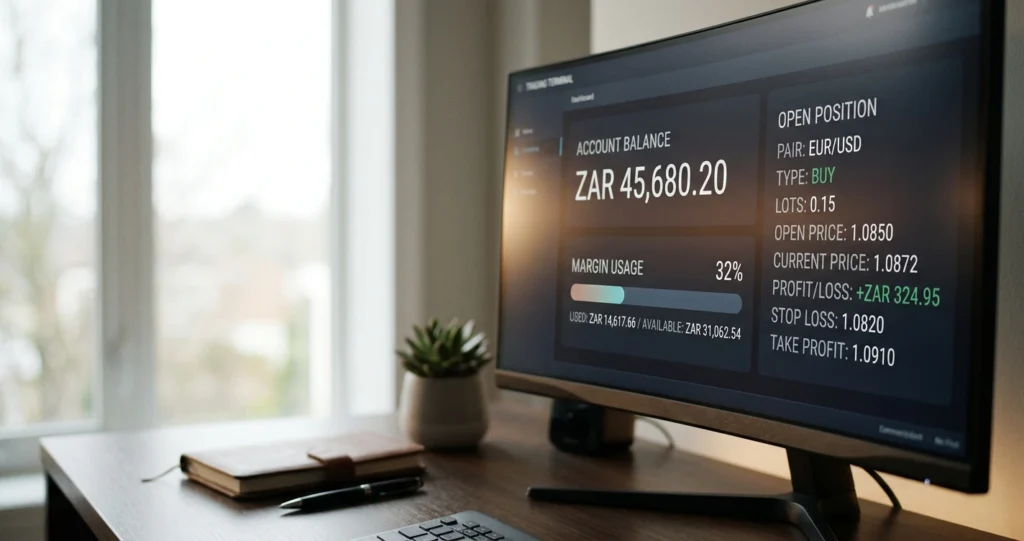
The most useful next step is to open a demo account and place a few trades at low leverage, watching how the used margin, free margin and margin level numbers change as price moves. Seeing those figures react in real time teaches the concept far better than reading about it. If you would rather have someone walk you through it in person, that is exactly what the coaching at CTFX School of Trading is built for.
Frequently asked questions
What is the difference between leverage and margin in forex?
Leverage is the ratio that lets you control a large position with a small amount of money, for example 1:100. Margin is the actual deposit the broker sets aside from your account to open and hold that position.
What is a good leverage for a forex beginner?
Most new South African traders are better off with low leverage such as 1:10 or 1:30, even when the broker offers much higher. The key is keeping your position size small, not chasing the biggest ratio you can find.
What happens during a margin call?
A margin call is a warning that your account equity has dropped too low to support your open trades. If the market keeps moving against you, the broker can close your positions automatically at a stop-out level to stop your balance going negative.
Does high leverage mean higher profit in forex?
No. Leverage does not increase the profit on a winning trade on its own. It only changes how large a position you can open, which raises both your potential gain and your potential loss in equal measure.
Want more of our forex education in your Google results?
