
CTFX Forex Help & Guides, CTFX Forex Tips & Tricks
Forex Regulations South Africa: 2025 Guide for SA

Jul
South Africans love the thrill of forex trading, but strict financial rules are changing the game. Did you know that the FSCA now requires all forex brokers to keep client funds in separate accounts and maintain minimum capital levels? This might sound like heavy-handed oversight, but it actually opens up smarter and safer opportunities for everyday traders as new allowances and legal interpretations shake up the scene for 2025.
Table of Contents
- Overview Of Forex Regulations In South Africa
- South African Exchange Control And Forex Trading
- Forex Licensing And Regulatory Bodies In Botswana
- Compliance Steps For Safe Forex Trading In 2025
Quick Summary
| Takeaway | Explanation |
|---|---|
| Robust Regulatory Framework | The Financial Sector Conduct Authority (FSCA) oversees forex trading in South Africa, ensuring compliance and investor protection through strict licensing requirements for brokers. |
| Exchange Control Regulations | South African residents face limitations on offshore investments, with specific allowances and requirements for transferring capital outside the country, impacting forex trading strategies. |
| Comprehensive Compliance Steps | Forex traders must adhere to detailed documentation and reporting standards, including transaction logs and identity verification, to comply with the Financial Advisory and Intermediary Services Act. |
| Risk Management Necessity | Implementing robust risk management strategies and maintaining adequate capital reserves are essential for protecting investor interests and ensuring financial stability in trading activities. |
| Technological Standards | Traders need to prioritize cybersecurity measures and comply with data protection regulations to safeguard against digital threats and to ensure secure trading operations. |
What Are the Forex Regulations in South Africa?
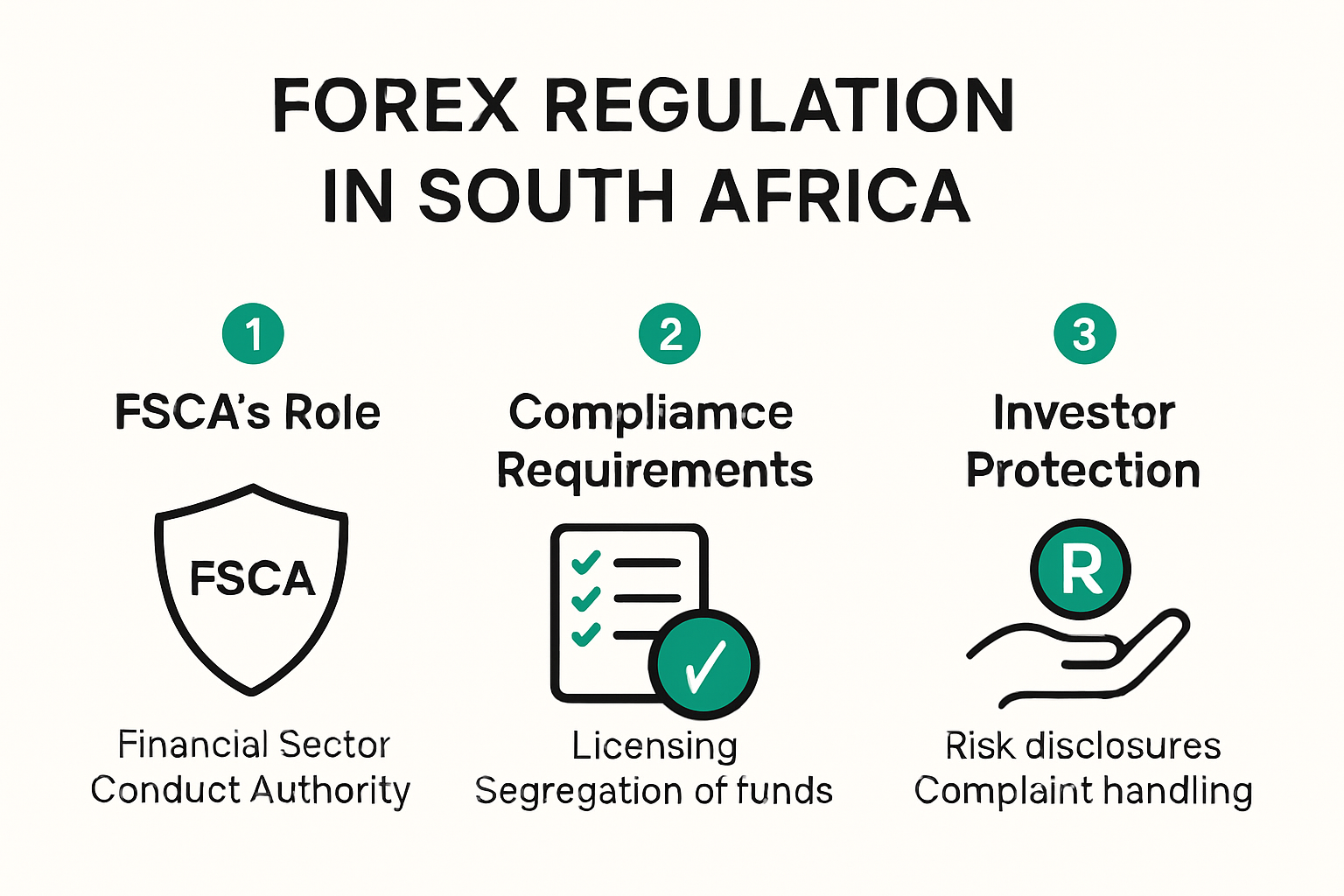
Forex trading in South Africa operates within a structured regulatory framework designed to protect investors and maintain market integrity. The Financial Sector Conduct Authority (FSCA) serves as the primary regulatory body responsible for overseeing forex trading activities and ensuring compliance with national financial standards.
Regulatory Framework and Key Institutions

South Africa’s forex regulatory landscape is characterized by robust oversight mechanisms that aim to safeguard both traders and financial markets. The FSCA, previously known as the Financial Services Board, plays a critical role in monitoring and regulating financial service providers. Traders and brokers must adhere to strict licensing requirements that ensure transparency, financial stability, and consumer protection.
Under South African law, forex brokers are mandated to obtain specific licenses demonstrating their capability to operate legally. These licensing requirements include maintaining adequate capital reserves, implementing comprehensive risk management systems, and ensuring client funds are held in segregated accounts. The regulatory framework is designed to prevent fraudulent activities and protect individual investors from potential financial misconduct.
Compliance and Investor Protection
Investor protection remains a fundamental priority within South African forex regulations. Research from the South African Reserve Bank indicates that regulatory measures are continuously updated to address emerging market challenges and technological advancements. Forex brokers must comply with multiple reporting requirements, including regular financial disclosures and risk assessments.
Key compliance standards include:
- Capital Adequacy: Brokers must maintain minimum capital levels to ensure financial stability.
- Transparent Reporting: Regular financial statements and transaction records are mandatory.
- Client Fund Segregation: Ensuring client funds are kept separate from operational funds.
Traders interested in understanding the nuanced regulatory environment can explore our comprehensive forex trading guidance to navigate these complex requirements effectively.
The regulatory environment in South Africa aims to create a balanced ecosystem that encourages forex trading while simultaneously protecting participants from undue risks. By implementing stringent oversight mechanisms, the FSCA ensures that forex trading remains a transparent and accountable financial activity.
Understanding these regulations is crucial for both novice and experienced traders. Compliance not only protects individual investors but also contributes to the overall stability and reputation of South Africa’s forex trading market.
To clarify the major regulatory requirements for forex brokers in South Africa, the following table organizes the key standards discussed above:
| Regulatory Requirement | Description |
|---|---|
| Capital Adequacy | Brokers must maintain minimum capital levels for financial stability |
| Transparent Reporting | Mandatory regular financial statements and transaction records |
| Client Fund Segregation | Client funds must be held separately from broker operational funds |
| Risk Management Systems | Comprehensive systems to prevent fraud and manage operational risks |
| Licensing by FSCA | Brokers must obtain licenses to operate legally in South Africa |
South African Exchange Control and Forex Trading
South African exchange control regulations play a crucial role in managing forex trading and international financial transactions. These regulations, primarily governed by the South African Reserve Bank (SARB), provide a comprehensive framework for managing capital flows and protecting the national economic interests.
Exchange Control Regulations and Forex Limitations
The exchange control framework in South Africa imposes specific restrictions on how individuals and businesses can conduct international financial transactions. According to the South African Reserve Bank guidelines, residents are subject to annual offshore investment allowances that limit the amount of capital they can transfer outside the country.
Individuals have two primary mechanisms for offshore investments: the single discretionary allowance and the foreign investment allowance. The single discretionary allowance permits South Africans to transfer up to R1 million per calendar year without requiring additional documentation. For investments beyond this threshold, traders must obtain specific approvals from authorized financial institutions.
Regulatory Developments and Capital Transfer Mechanisms
Research from the Investment Policy Monitor indicates significant recent developments in exchange control regulations. As of September 2024, the SARB introduced more flexible guidelines for businesses seeking to invest internationally. Companies can now transfer capital for foreign direct investment without strict monetary limitations, with investments up to R5 billion per calendar year approved directly by Authorized Dealers.
These regulatory changes reflect South Africa’s evolving approach to international financial interactions. Traders and investors must stay informed about the latest regulatory updates to ensure compliance and optimize their forex trading strategies.
Interesting legal interpretations have also emerged, such as the Pretoria High Court ruling which clarified that cryptocurrencies do not constitute traditional “capital” under exchange control regulations. This nuanced interpretation provides additional flexibility for digital asset traders.
For traders looking to navigate these complex regulatory landscapes, understanding forex trading fundamentals becomes essential. Comprehensive knowledge of exchange control mechanisms can help traders make informed decisions and remain compliant with national financial regulations.
The exchange control environment in South Africa demonstrates a balanced approach. While maintaining protective measures for the national economy, the regulations increasingly provide opportunities for legitimate international financial engagement. Traders must approach forex trading with a thorough understanding of these regulatory frameworks, ensuring both compliance and strategic financial planning.
The table below summarizes the main South African offshore allowance mechanisms and their features for individuals and businesses:
| Allowance Type | Max Amount Per Year | Approval Needed | Notes |
|---|---|---|---|
| Single Discretionary Allowance | R1 million | No | No extra documentation required |
| Foreign Investment Allowance | Above R1 million | Yes (Authorised Dealer) | Additional documentation and approval required |
| Company FDI Allowance | Up to R5 billion | Authorised Dealers | Applies to company capital transfer for foreign investment |
| Cryptocurrency Transfers | N/A | N/A | Not classified as capital under exchange regulations |
Forex Licensing and Regulatory Bodies in Botswana
Botswana’s forex regulatory landscape represents a sophisticated and evolving financial framework designed to protect investors and maintain market integrity. The country’s approach to financial regulation combines multiple institutions working collaboratively to oversee forex trading and related financial activities.
Primary Regulatory Institutions
The Non-Bank Financial Institutions Regulatory Authority (NBFIRA) serves as the primary regulatory body responsible for supervising non-bank financial institutions in Botswana. This organization plays a critical role in monitoring securities infrastructure businesses and ensuring compliance with national financial standards. NBFIRA’s mandate extends to overseeing various financial intermediaries, including forex trading platforms and related financial service providers.
The Ministry of Finance and Economic Development (MFED) complements NBFIRA’s efforts by formulating comprehensive regulatory frameworks. Their strategic approach involves developing robust guidelines that protect investor interests while simultaneously encouraging financial innovation and market growth.
Licensing Requirements and Compliance
Forex trading entities in Botswana must navigate a complex licensing process designed to ensure operational transparency and financial stability. Regulatory requirements typically include:
- Capital Adequacy: Demonstrating sufficient financial reserves to support trading operations
- Risk Management: Implementing comprehensive risk mitigation strategies
- Reporting Standards: Maintaining detailed financial documentation and periodic reporting
Traders seeking to understand the intricacies of forex regulations can explore comprehensive trading resources to gain deeper insights into compliance mechanisms.
Recent regulatory developments indicate a progressive stance towards financial technology and international trading standards. Research from the Botswana Stock Exchange suggests an increasing emphasis on aligning national regulations with global best practices, creating a more attractive environment for both local and international forex traders.
The regulatory ecosystem in Botswana demonstrates a nuanced balance between investor protection and market development. By maintaining stringent licensing requirements while remaining adaptable to technological advancements, Botswana continues to position itself as a sophisticated financial market within the southern African region.
Understanding these regulatory frameworks is crucial for traders and financial professionals. The comprehensive approach adopted by Botswana’s regulatory bodies ensures that forex trading remains a transparent, accountable, and potentially lucrative financial activity. Potential traders must invest time in comprehending these regulations to successfully navigate the complex forex trading landscape.
Compliance Steps for Safe Forex Trading in 2025
Forex trading in 2025 demands a sophisticated approach to compliance, with regulatory bodies implementing increasingly stringent measures to protect investors and maintain market integrity. Traders must navigate a complex landscape of legal and financial requirements to ensure safe and legitimate trading activities.
Regulatory Compliance and Documentation
According to the Financial Advisory and Intermediary Services Act, forex traders must adhere to comprehensive documentation and reporting standards. The Financial Sector Conduct Authority (FSCA) requires detailed record-keeping, including:
- Transaction Logs: Comprehensive documentation of all trading activities
- Identity Verification: Rigorous know-your-customer (KYC) protocols
- Financial Declarations: Regular reporting of trading income and financial status
Research from the Financial Action Task Force highlights the critical importance of these compliance measures in preventing financial crimes and ensuring transparent trading practices.
Risk Management and Investor Protection
In 2025, forex traders must implement robust risk management strategies that go beyond traditional approaches. The FSCA’s expanded supervisory capabilities emphasize the need for proactive risk mitigation. Key considerations include:
- Maintaining adequate capital reserves
- Implementing sophisticated risk assessment tools
- Developing comprehensive emergency trading protocols
Traders looking to enhance their understanding of these complex requirements can explore professional trading guidance to navigate the intricate compliance landscape effectively.
Technological Compliance and Security
Technological advancements have introduced new compliance challenges for forex traders. Cybersecurity and data protection have become paramount concerns. Traders must ensure:
- Secure trading platforms with advanced encryption
- Protection against digital financial fraud
- Compliance with data privacy regulations
The regulatory environment continues to evolve, with increased scrutiny of digital trading platforms. Traders must remain adaptable, continuously updating their knowledge and compliance strategies to meet the latest regulatory requirements.
Successful forex trading in 2025 requires more than just market knowledge. It demands a comprehensive understanding of regulatory frameworks, technological safeguards, and ethical trading practices. Investors who prioritize compliance and risk management will be best positioned to navigate the complex forex trading landscape, protecting both their financial interests and their legal standing.
Frequently Asked Questions
What are the main regulatory bodies overseeing forex trading in South Africa?
The Financial Sector Conduct Authority (FSCA) is the primary regulatory body overseeing forex trading in South Africa, ensuring compliance and investor protection.
How do exchange control regulations affect forex trading in South Africa?
Exchange control regulations impose limitations on how South African residents can conduct international financial transactions, including specific offshore investment allowances that impact forex trading strategies.
What are the licensing requirements for forex brokers in Botswana?
Forex brokers in Botswana must obtain licenses from the Non-Bank Financial Institutions Regulatory Authority (NBFIRA), which requires them to demonstrate capital adequacy, implement risk management strategies, and comply with reporting standards.
What compliance measures should forex traders follow for safe trading in 2025?
Forex traders should maintain detailed transaction logs, adhere to identity verification protocols, implement risk management strategies, and ensure robust cybersecurity measures to comply with regulatory standards.
Take the Uncertainty Out of Forex Compliance in 2025
Are you feeling overwhelmed by the complex forex regulations and shifting compliance requirements in South Africa and Botswana? Staying up to date with FSCA licensing rules, exchange control limitations, and new documentation standards can be stressful if you do not have the right support. Many traders struggle to turn regulatory knowledge into successful trades, especially when transparency and reporting mistakes risk losing hard-earned capital. If you want to move forward with confidence and clarity, you need more than just info — you need real-world guidance you can trust.

At CTFX School of Trading, we bring you almost a decade of hands-on forex experience tailored for South African regulations and the unique challenges discussed in the Forex Regulations South Africa: 2025 Guide for SA and Botswana. Our easy-to-understand coaching covers all the shifts in capital allowances, FSCA-compliant risk management, and up-to-date strategies for staying on top. Start your journey with proven support, practical tools, and the local expertise you need to meet every legal and financial standard. Visit CTFX today and claim your path to compliant, confident trading. The 2025 market is moving fast, so now is the time to secure your edge.
Recommended
- Best Forex Trading Course & Coaching: Cape Town South Africa
- Exclusive Private Forex Course – 1-on-1 Trading Training
- Expert-Led Group Forex Course – Learn & Trade Together
- Forex trading course pretoria – SA’s Best Forex Trading Course & Coaching Classes
- Expert-Led Group Forex Course – Learn & Trade Together
