
CTFX Forex Help & Guides, CTFX Forex Tips & Tricks
Day Trading Definition for South Africa

Jul
Day trading is attracting more South Africans and Batswana than ever before, with some platforms reporting a 35 percent surge in first-time traders between 2022 and 2024. Most people imagine quick wins and easy cash flying in every time the market moves. The real shock is that nearly all new traders lose money at the start, and success has little to do with luck. The actual winners treat day trading as a disciplined profession, thriving on hard rules, constant skill-building and nerves of steel.
Table of Contents
- What Is The Day Trading Definition?
- How Day Trading Works In South Africa And Botswana
- Key Risks And Rewards Of Day Trading
- Essential Tips For New Day Traders In 2025
Quick Summary
| Takeaway | Explanation |
|---|---|
| Regulatory Compliance is Essential | Traders in South Africa and Botswana must adhere to regulations imposed by the FSCA and NBFIRA, ensuring market integrity and protecting investor interests through strict reporting and risk management protocols. |
| Technological Proficiency is Crucial | Successful day trading relies on advanced digital platforms providing real-time data and fast execution capabilities, highlighting the need for traders to effectively utilize technology to stay competitive. |
| Risk Management Must Be a Priority | Traders are urged to implement strict stop-loss protocols and diversify trading instruments to mitigate financial risks associated with market volatility. |
| Continuous Education is Key to Success | Aspiring traders should invest in advanced learning, focusing on technical analysis, complex charting techniques, and emotional discipline to enhance their trading strategies. |
| Financial Planning is Fundamental | New traders should start with capital they can afford to lose, create comprehensive trading plans, and maintain realistic expectations regarding profits and losses for sustainable trading success. |
What Is the Day Trading Definition?
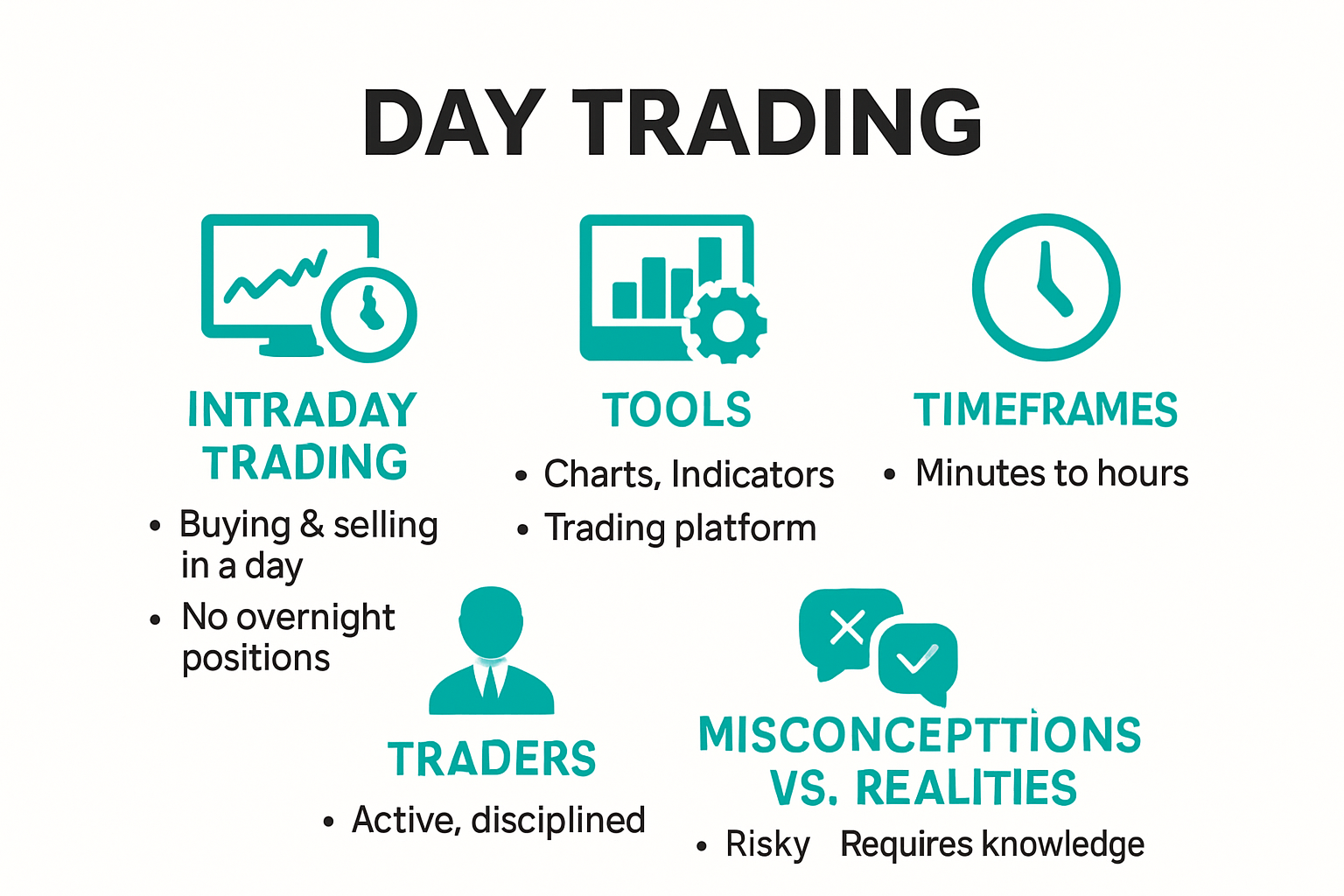
Day trading represents a dynamic and fast-paced approach to financial markets where traders execute multiple buying and selling transactions within a single trading day. This strategy aims to capitalize on short-term price fluctuations across various financial instruments such as stocks, forex, commodities, and cryptocurrencies.
Understanding the Core Mechanics
At its fundamental level, day trading involves opening and closing financial positions within the same trading session, with traders never holding positions overnight. The primary objective is to generate profits from incremental price movements rather than long-term investment strategies. Traders utilize sophisticated technical analysis, real-time market data, and rapid decision-making skills to identify potential trading opportunities.
According to the Financial Markets Act of 2012, day trading in South Africa operates within a regulated framework designed to ensure market transparency and protect investor interests. This legislation provides critical guidelines that help maintain the integrity of financial transactions and prevent potential market manipulation.
Risk and Reward Dynamics
Day trading is not for the faint-hearted. It demands a combination of technical knowledge, psychological resilience, and robust risk management strategies. Professional traders understand that success hinges on more than just market predictions – it requires disciplined execution and comprehensive market understanding.
The potential returns can be significant, but so are the risks. Traders must be prepared to handle rapid market volatility, manage potential losses, and maintain strict emotional control. Quick decision-making, coupled with a deep understanding of market indicators, becomes crucial in this high-stakes trading environment.
Interestingly, while the South African Revenue Service does not provide a specific definitional categorization for day trading, tax implications remain an important consideration for traders. Profits generated through day trading are typically treated as income and are subject to appropriate taxation protocols.
Key characteristics that define day trading include:
- Rapid Transaction Cycles: Trades completed within the same trading day
- Active Market Engagement: Continuous monitoring of price movements
- Technical Analysis Focus: Reliance on charts, indicators, and real-time data
Understanding the day trading definition goes beyond a simple transactional explanation. It represents a sophisticated approach to financial markets that requires continuous learning, adaptability, and a strategic mindset. Successful day traders view this method not just as a trading style, but as a disciplined profession demanding constant skill refinement and market awareness.
How Day Trading Works in South Africa and Botswana
Day trading in South Africa and Botswana operates within complex regulatory environments that demand strategic understanding and precise execution. Traders in these regions navigate unique market landscapes characterized by technological infrastructure, regulatory frameworks, and distinct economic conditions.
Regulatory and Market Infrastructure
In South Africa, day trading activities are governed by the Financial Sector Conduct Authority (FSCA), which ensures market integrity and investor protection. Traders must comply with strict regulatory requirements that mandate transparent reporting and risk management protocols. Learn more about advanced trading strategies for navigating these intricate market conditions.
Botswana presents a similarly structured market environment. The Non-Bank Financial Institutions Regulatory Authority (NBFIRA) plays a critical role in overseeing capital markets, establishing guidelines that promote market stability and protect investor interests. This regulatory oversight ensures that day traders operate within a controlled and transparent ecosystem.
Technological and Trading Platforms
Modern day trading in both countries relies heavily on sophisticated digital platforms that provide real-time market data, advanced charting tools, and instant execution capabilities. Traders utilize multiple screens, high-speed internet connections, and specialized software to analyze market trends, execute trades, and manage risk in microseconds.
According to research from the Botswana Stock Exchange, technological infrastructure has significantly transformed trading dynamics. Electronic trading platforms enable traders to access international markets, diversify investment portfolios, and implement complex trading strategies with unprecedented speed and precision.

Tax and Financial Considerations
Day trading profits in these regions are subject to specific tax regulations. In Botswana, income tax rates for trading profits range from 0% to 25% depending on individual income brackets. Traders must maintain meticulous financial records to ensure accurate tax reporting and compliance.
Key operational characteristics of day trading in South Africa and Botswana include:
- Regulatory Compliance: Strict adherence to financial market regulations
- Technological Integration: Advanced digital trading platforms
- Risk Management: Continuous monitoring and strategic decision-making
Successful day traders in these markets understand that success requires more than technical skills. It demands a holistic approach that combines regulatory knowledge, technological proficiency, and adaptive trading strategies. The ability to interpret complex market signals, manage risk effectively, and maintain emotional discipline distinguishes professional traders in these dynamic financial landscapes.
Below is a table comparing the regulatory authorities and market features in South Africa and Botswana for day traders. It provides a quick overview of the differences and similarities, helping traders understand their operating environment.
| Feature | South Africa | Botswana |
|---|---|---|
| Regulatory Authority | Financial Sector Conduct Authority (FSCA) | Non-Bank Financial Institutions Regulatory Authority (NBFIRA) |
| Key Legislation | Financial Markets Act of 2012 | NBFIRA Guidelines |
| Market Transparency | High | Moderate to High |
| Tax Rate on Trading Profits | Treated as income; variable rates | 0% – 25% depending on income bracket |
| Technological Infrastructure | Advanced digital platforms and real-time data | Growing access to digital platforms and international markets |
| Investor Protection | Strict, regulated | Regulated |
| Access to International Markets | Supported via electronic trading | Supported via electronic trading |
Key Risks and Rewards of Day Trading
Day trading represents a high-stakes financial strategy that simultaneously offers extraordinary potential rewards and significant risks. Understanding this intricate balance becomes crucial for traders seeking success in volatile market environments.
Financial Volatility and Potential Returns
Day trading presents a unique landscape of financial opportunities where rapid market movements can translate into substantial profits or devastating losses. According to research from financial analysts, successful traders can generate impressive returns by capitalizing on short-term price fluctuations. However, this potential comes with an equally significant probability of financial setbacks.
Potential Rewards:
- Immediate profit generation
- Flexibility in trading multiple financial instruments
- No overnight market risk
Traders who develop robust strategies and maintain disciplined approaches can potentially outperform traditional long-term investment methods. Our comprehensive trading guide offers insights into navigating these complex market dynamics effectively.
Psychological and Operational Challenges
Emotional management represents a critical yet often overlooked aspect of day trading. Psychological research indicates that impulsive decision-making can lead to significant financial losses. Successful traders must cultivate mental resilience, maintaining objectivity despite rapid market changes and potential financial pressure.
Key psychological challenges include:
- Managing fear and greed
- Controlling emotional responses to market movements
- Maintaining consistent trading discipline
Regulatory and Financial Risks
Navigating the regulatory landscape adds another layer of complexity to day trading. Regulatory frameworks in South Africa continuously evolve, demanding traders remain vigilant about compliance and potential legal implications. Financial risks include potential capital loss, transaction costs, and tax obligations.
Critical risk management strategies involve:
- Implementing strict stop-loss protocols
- Diversifying trading instruments
- Continuously educating oneself about market dynamics
Understanding day trading risks requires acknowledging that success is not guaranteed. Traders must approach this financial strategy with comprehensive knowledge, emotional intelligence, and a commitment to continuous learning. While potential rewards can be substantial, the path demands unwavering discipline, strategic thinking, and a realistic assessment of personal financial capabilities.
The following table summarises the main risks and rewards of day trading as discussed in this section. It is designed to provide a concise reference for both new and experienced traders.
| Aspect | Key Rewards | Key Risks |
|---|---|---|
| Financial | Immediate profit potential, no overnight risk | Significant losses, capital depletion, transaction costs |
| Flexibility | Multiple instruments, short-term opportunities | High entry barrier for skill and capital |
| Psychological | Skill-building, mental discipline | Stress, emotional decision-making, burnout |
| Regulatory/Compliance | Transparent and protected market access | Regulatory breaches, legal consequences |
| Operational | Advanced tech tools, real-time data | Platform failures, execution errors |
Essential Tips for New Day Traders in 2025
Navigating the complex world of day trading requires strategic preparation, continuous learning, and a disciplined approach. As we move into 2025, new traders must equip themselves with comprehensive knowledge and advanced strategies to survive in increasingly competitive financial markets.
Educational Foundation and Skill Development
Building a robust educational foundation becomes paramount for aspiring day traders. Learn advanced trading techniques that go beyond basic market understanding. According to research from market analysts, most day traders initially struggle due to insufficient preparation and lack of comprehensive market knowledge.
Key educational priorities include:
- Understanding technical analysis
- Learning complex charting techniques
- Developing risk management skills
- Mastering emotional discipline
Successful traders recognize that continuous learning represents an ongoing journey. They invest time in studying market trends, technological advancements, and evolving trading platforms.
Technology and Risk Management
Modern day trading in 2025 demands sophisticated technological integration. Traders must leverage advanced digital tools, real-time data analytics, and robust trading platforms. The ability to quickly process market information and execute trades becomes crucial.
Risk management strategies are no longer optional but essential. According to the U.S. Securities and Exchange Commission, most day traders experience significant financial losses. Critical risk mitigation techniques include:
- Implementing strict stop-loss protocols
- Diversifying trading instruments
- Using position sizing strategies
- Maintaining disciplined trading rules
Psychological Preparedness and Financial Planning
Psychological resilience distinguishes successful traders from novices. Understanding personal emotional triggers, managing stress, and maintaining objectivity during volatile market conditions become critical skills. Traders must develop a disciplined mindset that separates emotional impulses from rational decision-making.
Financial planning involves more than just trading capital. New traders should:
- Start with capital they can afford to lose
- Create a comprehensive trading plan
- Set realistic profit and loss expectations
- Maintain detailed trading journals
The journey of a day trader in 2025 requires a holistic approach that combines technological proficiency, continuous education, robust risk management, and unwavering psychological discipline. Success emerges from understanding that day trading is not a get-rich-quick scheme but a professional skill demanding dedicated learning, practice, and strategic execution.
Frequently Asked Questions
What is day trading?
Day trading is a trading strategy where traders buy and sell financial instruments within the same trading day, aiming to capitalize on short-term price fluctuations.
How does day trading work in South Africa and Botswana?
In South Africa and Botswana, day trading operates under strict regulations by the FSCA and NBFIRA, requiring compliance with reporting and risk management protocols. Traders use advanced digital platforms for executing trades and analyzing market data.
What are the risks and rewards of day trading?
Day trading offers the potential for significant profits from quick market movements, but also comes with high risks, including financial loss, emotional stress, and regulatory challenges.
What should new traders know before starting day trading in 2025?
New traders should focus on building a strong educational foundation, mastering technology for trading, implementing risk management strategies, and maintaining psychological discipline to succeed in day trading.
Turn Day Trading Knowledge into Profitable Skills with CTFX
Are you feeling overwhelmed by the high risks and complex demands of day trading in South Africa and Botswana? The article reveals how most first-time traders struggle with rapid market shifts and strict regulations, often losing money due to a lack of solid guidance, technical skill and emotional discipline. What if you could confidently master these challenges with support from an expert who has walked this path for nearly a decade?

Now is the time to put your learning into action with step-by-step mentoring. At CTFX School of Trading, we specialise in making trading simple and effective for everyone. Discover a proven approach to technical analysis, mindset and advanced risk management designed for South African and Batswana traders. Whether you need to deepen your understanding of forex trading concepts or sharpen your day trading strategies, our course and personal coaching give you the confidence to trade smart and stay resilient. Visit CTFX School of Trading now and level up your day trading journey without delay.
Recommended
- Best Forex Trading Course & Coaching: Cape Town South Africa
- Exclusive Private Forex Course – 1-on-1 Trading Training
- Forex trading course pretoria – SA’s Best Forex Trading Course & Coaching Classes
- Expert-Led Group Forex Course – Learn & Trade Together
- Free Intro – SA’s Best Forex Trading Course & Coaching Classes
