
CTFX Forex Help & Guides, CTFX Forex Tips & Tricks
Forex Trading Tax South Africa: 2025 Guide
Jul
Trading tax keeps getting more complicated in South Africa and Botswana. Individual traders could face tax rates as high as 45 percent depending on how they’re classified. Most people think the trickiest part is dodging the paperwork or finding hidden deductions. That’s not it at all. The real curveball comes from how SARS decides what type of trader you are. One subtle difference might double your tax bill overnight.
Table of Contents
- Understanding Trading Tax Rules In South Africa
- Tax Reporting For South African And Botswana Traders
- Tips To Stay Compliant And Reduce Your Tax
Quick Summary
| Takeaway | Explanation |
|---|---|
| Classification of Trading Income Matters | Traders should understand the distinction between revenue income and capital gains, as it affects tax rates based on trading frequency, intent, and asset types. |
| Accurate Documentation is Crucial | Maintaining detailed transaction records, profit and loss statements, and other relevant documents is essential for compliance and accurate tax reporting. |
| Tax Deductions Can Reduce Liability | Traders should leverage legitimate tax deductions, like trading-related expenses and educational costs, to minimize their overall tax burden. |
| Stay Informed about Filing Deadlines | Awareness of specific filing periods and compliance requirements is necessary to avoid penalties; professional consultations may be beneficial. |
| Adopt Tax-Efficient Strategies | Using long-term investment holding, tax-loss harvesting, and diversification can strategically enhance tax efficiency and reduce liabilities. |
What Are the Trading Tax Rules in South Africa?
Trading tax in South Africa represents a complex landscape of financial regulations that every trader must comprehend to remain compliant and optimize their tax strategy. The South African Revenue Service (SARS) has established specific guidelines for determining how trading income is classified and taxed, which can significantly impact a trader’s financial obligations.
Classification of Trading Income
In South Africa, trading income is categorized based on the nature and frequency of your trading activities. The primary distinction lies between capital gains and revenue income, which determines the tax treatment. Learn more about trading strategies that impact tax classification.
According to the National Treasury’s 2025 Draft Revenue Laws Amendment Bill, the classification depends on several key factors:
- Frequency of Transactions: Regular, frequent trading suggests revenue income
- Intent of Trading: Whether the primary purpose is short-term profit generation
- Nature of Assets: Different rules apply for stocks, forex, cryptocurrencies
Traders engaging in frequent transactions are more likely to be classified as active traders, which means their profits are taxed as income rather than capital gains. This classification can result in higher tax rates compared to long-term investment strategies.
Tax Rates and Calculation Methods
The Global Minimum Tax Act 46 of 2024 introduces additional complexity to tax calculations for traders. For individual traders, the current tax rates range from 18% to 45%, depending on total annual income. Professional traders might be subject to different calculation methods compared to casual investors.
Key considerations for tax calculation include:
- Maintaining detailed transaction records
- Tracking all trading-related expenses
- Understanding the difference between revenue income and capital gains
- Reporting all trading income accurately to SARS
Traders must also consider potential deductions, such as trading-related expenses, which can help reduce overall tax liability. These might include platform fees, research costs, and professional development expenses directly related to trading activities.
Navigating the intricate trading tax rules requires careful attention to detail and potentially seeking professional tax advice. While the regulations might seem overwhelming, understanding them thoroughly can help traders make more informed financial decisions and maintain compliance with South African tax laws.
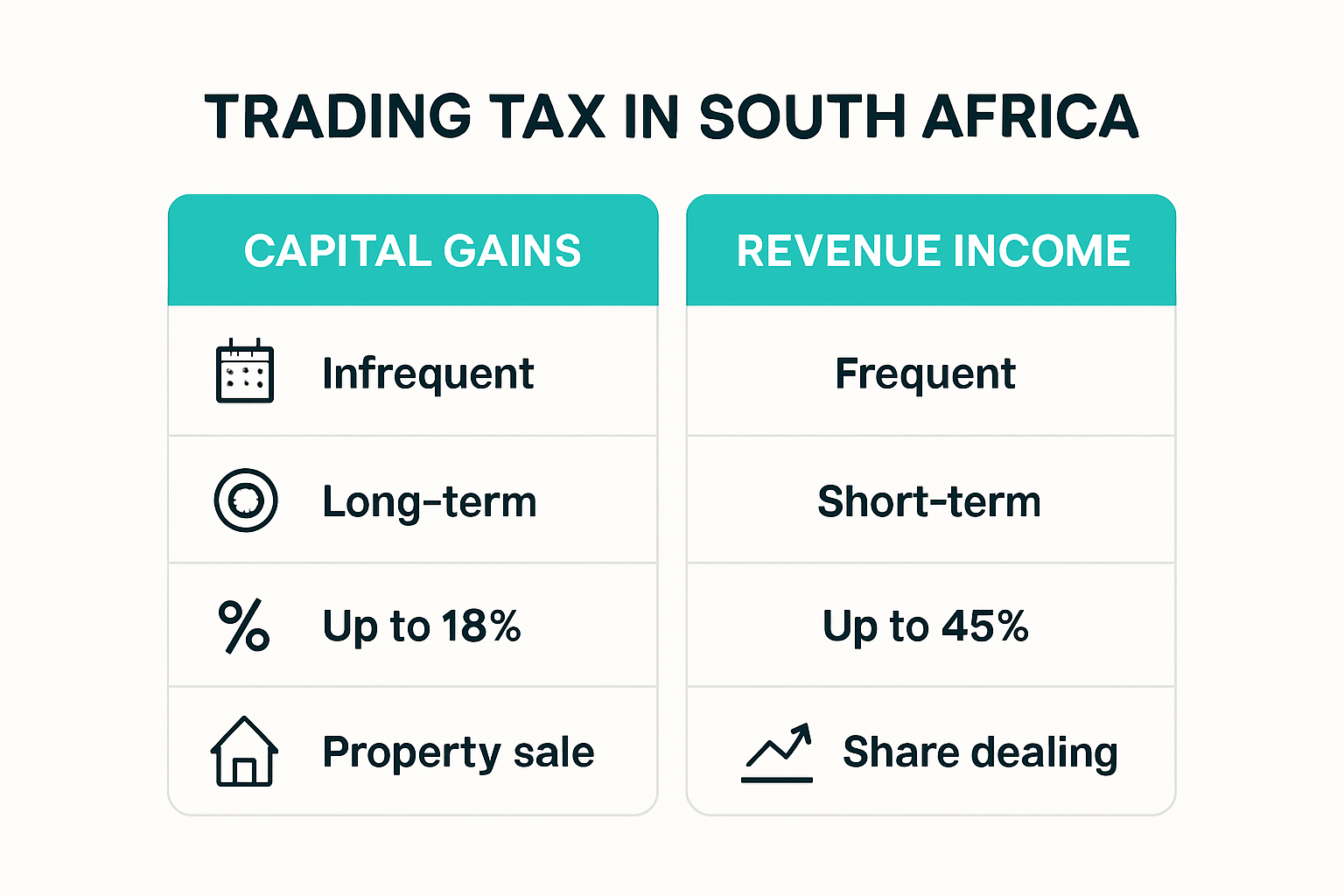
Here’s a comparison table highlighting the key differences between Revenue Income and Capital Gains classification for traders, as referenced above:
| Factor | Revenue Income (Active Trading) | Capital Gains (Investment) |
|---|---|---|
| Frequency of Transactions | Frequent, regular trades | Infrequent, long-term holding |
| Tax Rate Applied | Marginal personal income tax rate (18%-45%) | Capital gains tax (effective max ~18%) |
| Intent of Activity | Short-term profit generation | Long-term investment growth |
| Nature of Assets | Stocks, forex, cryptocurrencies, other securities | Typically shares, property, long-term investments |
| Deduction Eligibility | Broad range of trading-related deductions | Limited, mainly cost base and capital improvements |
| SARS View | Likely taxed as income | Likely taxed as capital gains |
Tax Reporting for South African and Botswana Traders
Tax reporting for traders in South Africa demands precision, thorough documentation, and strict adherence to regulatory requirements. The process involves multiple critical steps that can significantly impact a trader’s financial compliance and potential tax liability.
Documentation and Record Keeping
Accurate record keeping forms the foundation of successful tax reporting. According to the SARS MobiApp guidelines, traders must maintain comprehensive documentation of all trading activities. This includes:
- Detailed transaction logs
- Profit and loss statements
- Bank statements
- Broker confirmations
- Digital wallet transaction histories
Learn essential strategies for tracking your trading activities to ensure seamless tax reporting. The Tshwane University of Technology emphasizes the importance of gathering all relevant financial documents before tax season, including IRP5 certificates, interest income statements, and investment-related documentation.

Cryptocurrency and Digital Asset Reporting
SARS has intensified its focus on cryptocurrency traders for the 2024/2025 fiscal year. Regulatory insights from Polity.org reveal that traders must carefully report crypto transactions, distinguishing between capital gains and income-based transactions. Key reporting requirements include:
- Declaring all cryptocurrency transactions
- Distinguishing between trading and investment activities
- Reporting profits from digital asset exchanges
- Maintaining transparent records of all crypto trades
Traders should be aware that SARS is collaborating with crypto exchanges to cross-reference reported information, making accurate reporting crucial to avoid potential penalties.
Filing Deadlines and Compliance
The annual tax filing period requires traders to be particularly attentive. The Employer Annual Reconciliation Declarations (EMP501) are due from 1 April to 31 May 2025, with specific requirements for different types of traders. Professional traders must pay special attention to:
- Submitting accurate income declarations
- Calculating correct tax liabilities
- Meeting submission deadlines
- Reporting both local and international trading income
Non-compliance can result in significant penalties, making it essential to understand and meet all tax reporting obligations. Traders are strongly advised to consult with tax professionals who specialize in trading income to ensure full compliance with South African tax regulations.
Navigating the complex landscape of tax reporting requires diligence, attention to detail, and a proactive approach to financial documentation. By maintaining comprehensive records and staying informed about the latest regulatory requirements, traders can successfully manage their tax obligations and minimize potential risks.
The checklist below summarises the essential documents and activities South African traders should prepare and track for annual tax reporting:
| Documentation/Action | Required for SARS Compliance |
|---|---|
| Detailed transaction logs | Yes |
| Profit and loss statements | Yes |
| Bank statements | Yes |
| Broker confirmations | Yes |
| Digital wallet transaction history | Yes |
| IRP5 certificates | If applicable |
| Interest income statements | If applicable |
| Crypto asset transaction details | Yes (if trading crypto) |
Tips to Stay Compliant and Reduce Your Tax
Managing tax obligations effectively requires strategic planning and a proactive approach. Traders in South Africa can optimize their tax position by implementing careful strategies that balance compliance with financial efficiency.
Strategic Record Keeping and Documentation
Maintaining meticulous financial records is your first line of defense against potential tax complications. Explore advanced trading strategies that support efficient record management. According to the South African National Treasury’s 2024 Budget Review, traders should focus on:
- Comprehensive Transaction Logs: Document every trade with precise details
- Digital Backup Systems: Maintain multiple backup copies of financial records
- Expense Tracking: Carefully log all trading-related expenses for potential deductions
Digital tools and accounting software can significantly streamline this process, ensuring accuracy and reducing the risk of manual errors. Consistent and detailed documentation demonstrates transparency to tax authorities and provides a clear financial trail.
Leveraging Legal Tax Deductions
Understanding and strategically applying available tax deductions can substantially reduce your overall tax liability. Professional traders can benefit from various legitimate deduction strategies:
- Trading platform subscription costs
- Internet and communication expenses directly related to trading
- Professional development and educational courses
- Home office expenses if trading constitutes a primary business activity
- Research software and market analysis tools
Traders must ensure these deductions are genuine, directly connected to trading activities, and meticulously documented. Consulting with a tax professional specializing in trading income can help identify nuanced deduction opportunities specific to your trading profile.
Timing and Investment Strategies
Tax-efficient investment timing can significantly impact your overall tax liability. Consider these strategic approaches:
- Long-Term Investment Holding: Assets held longer may qualify for more favorable capital gains tax treatment
- Tax-Loss Harvesting: Strategically selling underperforming investments to offset gains
- Retirement Account Contributions: Utilize tax-advantaged retirement investment vehicles
- Diversification: Spread investments across different asset classes to optimize tax efficiency
The key is understanding the intricate relationship between trading frequency, investment duration, and tax classification. Some traders might benefit from adjusting their trading strategy to align with more tax-efficient approaches.
Staying compliant requires continuous learning and adaptation. Tax regulations evolve, and what works this year might change in the next. Regularly updating your knowledge, maintaining transparent records, and seeking professional advice can help you navigate the complex landscape of trading taxation in South Africa.
Remember, while minimizing tax is important, it should never compromise legal compliance. Always prioritize accuracy, transparency, and ethical financial practices in your trading journey.
Frequently Asked Questions
What are the tax rates for individual traders in South Africa?
Individual traders in South Africa face tax rates ranging from 18% to 45%, depending on their total annual income and whether they are classified as active traders or investors.
How is trading income classified in South Africa?
Trading income is classified based on the frequency of transactions, the intent behind the trading activities, and the nature of the assets involved. Active traders typically face income tax rates, while long-term investors may benefit from lower capital gains tax rates.
What records do traders need to keep for tax reporting?
Traders must maintain detailed transaction logs, profit and loss statements, bank statements, broker confirmations, and digital wallet transaction histories to ensure compliance with SARS tax reporting requirements.
Are there any tax deductions available for traders in South Africa?
Yes, traders can leverage various legitimate tax deductions, including trading platform fees, internet costs, educational expenses, and home office costs, to reduce their overall tax liability.
Struggling With Trading Tax Complexity? Get Expert Guidance Tailored for South African Traders
Many South African traders feel overwhelmed by the maze of SARS tax rules and the real fear of overpaying due to incorrect trading income classification. If you related to the confusion around tax rates, capital gains, and record-keeping discussed in our guide, you are not alone. Missing out on key deductions or getting your trading status wrong could cost you thousands each year. You deserve to feel confident about both your trading and your compliance, and that is where personalised, practical coaching makes the real difference. Our CTFX Course List shows how our step-by-step coaching and courses tackle these exact problems head-on. We know from experience what South African and Botswana traders need to stay compliant and maximise profits.

Stop letting tax stress hold back your growth. Join the CTFX School of Trading and move forward with a coach who speaks your language and understands local trading tax challenges. See how our simple practical courses and coaching can fast-track your confidence and trading results at CTFX Free Training & Resources. Take the first step today to stay on SARS’ good side and keep more of what you earn.
Recommended
- Stock Market for Beginners: Easy Guide for South Africa & Botswana 2025 – SA’s Best Forex Trading Course & Coaching Classes
- Best Trend Trading Strategies for South Africa and Botswana 2025 – SA’s Best Forex Trading Course & Coaching Classes
- Top Swing Trading Strategies for 2025: South Africa & Botswana – SA’s Best Forex Trading Course & Coaching Classes
- Common Forex Scams South Africa: Protect Yourself in 2025 – SA’s Best Forex Trading Course & Coaching Classes
