
CTFX Forex Help & Guides, CTFX Forex Tips & Tricks
Trading Financial Markets in Cape Town: 2025 Guide

Jul
Trading financial markets in Cape Town is gaining serious traction. The Johannesburg Stock Exchange is now actually Africa’s biggest securities exchange, handling hundreds of listed companies and billions of rands in daily trade. Everyone talks about the hustle of big international markets, but few realise that south african regulations offer some of the world’s strongest investor protection. Cape Town investors are already seizing new momentum strategies and growing their portfolios in ways that might just surprise you.
Table of Contents
- Understanding financial markets in south africa
- Top trading strategies for cape town investors
- Choosing the right platforms for local traders
- Managing risks when trading financial markets
Quick Summary
| Takeaway | Explanation |
|---|---|
| Understand South Africa’s market structure | South Africa’s trading primarily revolves around the Johannesburg Stock Exchange, offering diverse instruments such as equities and bonds. |
| Implement effective risk management strategies | Use techniques like stop-loss orders and diversification to mitigate financial risks while trading. |
| Leverage local trading platforms for tailored support | Choose trading platforms that comply with local regulations and offer features suited to regional market needs. |
| Utilize momentum and technical analysis for trading | Focus on momentum investing for short-term gains, relying on indicators like MACD for decision-making. |
| Stay educated on market dynamics and trends | Continuous learning about financial markets enhances trading strategies and adaptability to changing economic conditions. |
What Are the Financial Markets in South Africa?
Trading financial markets in South Africa represents a dynamic and complex ecosystem that offers unique opportunities and challenges for investors and traders. The south african financial landscape is characterized by robust regulatory frameworks, diverse market instruments, and a sophisticated trading infrastructure that attracts both local and international participants.
Market Structure and Key Components
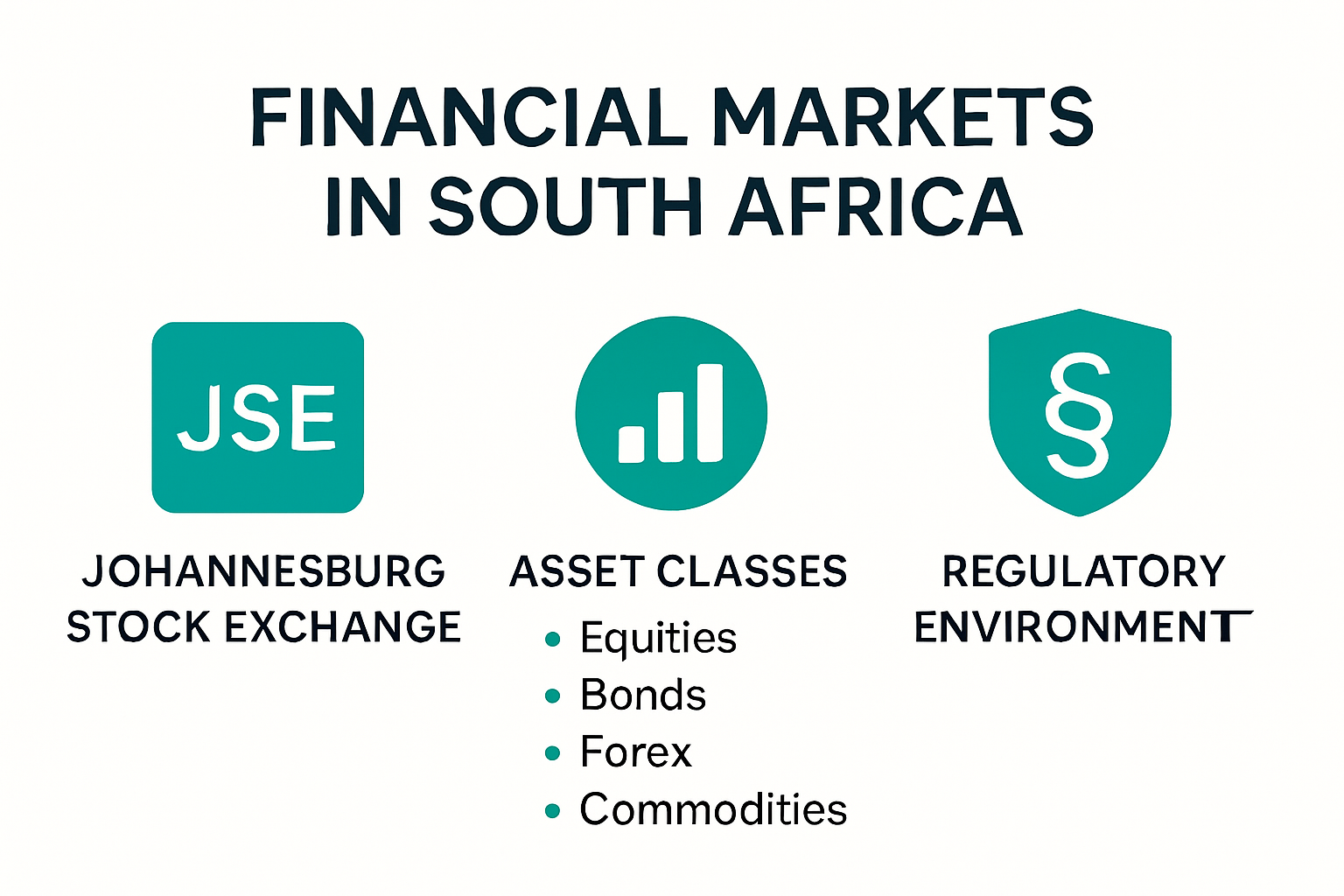
South Africa’s financial markets are predominantly centered around the Johannesburg Stock Exchange (JSE), which is the largest securities exchange in Africa. The JSE provides a comprehensive platform for trading various financial instruments, including equities, bonds, derivatives, and exchange-traded funds. According to the International Monetary Fund’s 2022 Article IV Consultation report, the country’s financial sector demonstrates significant resilience and sophisticated risk management practices.
The market ecosystem encompasses several critical segments:
- Equity Markets: Featuring hundreds of listed companies across multiple sectors
- Foreign Exchange Markets: Providing substantial liquidity and trading volumes
- Commodity Markets: Reflecting South Africa’s strong mining and resources sector
Regulatory Environment and Investment Protection
Trading financial markets in South Africa operates under strict regulatory oversight. The Financial Sector Conduct Authority (FSCA) plays a crucial role in maintaining market integrity, protecting investor interests, and ensuring transparent trading practices. Research from the South African Reserve Bank indicates that the regulatory framework has been progressively modernized to align with international best practices.
Investors and traders can benefit from a well-structured legal environment that provides:
- Clear compliance guidelines
- Investor protection mechanisms
- Transparent reporting requirements
- Robust risk management protocols
Market Opportunities and Global Connectivity
The south african financial markets offer unique advantages for traders seeking diversification and growth. With its strategic geographic location and advanced technological infrastructure, the market serves as a gateway for international investors interested in African market exposure. Sophisticated trading platforms, competitive transaction costs, and a wide range of financial instruments make trading financial markets a compelling opportunity for both novice and experienced traders.
Key factors that distinguish south african financial markets include advanced digital trading technologies, increasing market digitalization, and a growing ecosystem of financial technology solutions that enhance trading accessibility and efficiency.
Top Trading Strategies for Cape Town Investors
Trading financial markets requires strategic approaches tailored to individual risk tolerance, financial goals, and market conditions. Cape Town investors can leverage multiple sophisticated strategies to optimize their investment potential and manage portfolio risks effectively.
Momentum and Technical Analysis Strategies
Momentum investing represents a dynamic approach for traders seeking short-term gains. According to research from investment analysis, combining momentum indicators like Moving Average Convergence Divergence (MACD) with other technical tools can significantly enhance trading performance. Traders utilizing this strategy focus on securities demonstrating strong upward price trends, capitalizing on market movements.
Key components of momentum trading include:
- Trend Identification: Analyzing price movements and market trends
- Entry and Exit Points: Precise timing based on technical indicators
- Risk Management: Implementing stop-loss strategies to limit potential losses
Exploring trend trading techniques can provide investors with advanced insights into market dynamics and potential opportunities.
Diversification and Risk Mitigation

Diversification remains a fundamental strategy for Cape Town investors seeking robust portfolio management. Research from the SEC emphasizes spreading investments across various asset classes, sectors, and geographical regions to reduce overall investment risk. This approach helps investors minimize potential losses from poor-performing individual investments.
Effective diversification strategies include:
- Investing across multiple financial instruments
- Balancing high-risk and low-risk assets
- Regularly rebalancing investment portfolios
- Exploring international market opportunities
Advanced Trading Techniques
Sophisticated Cape Town investors can leverage advanced trading techniques that combine technical analysis, fundamental research, and strategic planning. Swing trading emerges as a powerful approach for those seeking to capture gains from short to medium-term market movements.
Swing trading strategies involve:
- Analyzing market trends over days or weeks
- Identifying potential price reversals
- Utilizing both technical and fundamental analysis
- Maintaining flexibility in trading positions
Successful implementation requires continuous learning, disciplined risk management, and a deep understanding of market dynamics. Investors should continuously educate themselves, stay updated on market trends, and be prepared to adapt their strategies as economic conditions evolve.
Choosing the Right Platforms for Local Traders
Selecting the appropriate trading platform is crucial for Cape Town investors seeking to navigate financial markets effectively. The right platform can significantly impact trading performance, providing tools, resources, and interfaces that align with individual investment strategies and goals.
Evaluating Trading Platform Features
Modern trading platforms offer a comprehensive suite of features designed to empower local traders. According to research from financial technology analysts, key considerations include user interface, execution speed, transaction costs, and available market instruments.
Critical features traders should examine include:
- Real-time Market Data: Instant price updates and market insights
- Advanced Charting Tools: Technical analysis capabilities
- Risk Management Features: Stop-loss and take-profit mechanisms
- Mobile Compatibility: Seamless trading across devices
Learn about starting your trading journey can provide additional insights into platform selection and trading fundamentals.
Security and Regulatory Compliance
Trading platforms must meet stringent security standards and regulatory requirements specific to south african financial markets. The Financial Sector Conduct Authority guidelines emphasize the importance of choosing platforms registered with local regulatory bodies.
Key security considerations include:
- Encrypted transactions
- Two-factor authentication
- Segregated client funds
- Transparent fee structures
- Regular security audits
Local vs International Trading Platforms
Below is a table comparing local South African and international trading platforms, helping Cape Town traders assess which option best fits their needs.
| Feature | Local SA Trading Platforms | International Trading Platforms |
|---|---|---|
| Regulatory Compliance | Aligned with FSCA/local laws | Varies by jurisdiction |
| Market Access | JSE & regional markets | Global markets |
| Support & Service | Localised, regional expertise | Global support, may lack local |
| Currency Handling | ZAR deposits/withdrawals | Often requires forex conversion |
| Platform Technology | Tailored to SA needs | Often more advanced |
| Fees & Costs | May be higher/region-specific | Potentially lower, varies |
| Product Range | Equities, bonds, selected assets | Broader (stocks, forex, CFDs, etc) |
Cape Town traders have the option of choosing between local south african platforms and international trading solutions. Each offers unique advantages and potential limitations. Local platforms often provide more tailored support, understanding of regional market nuances, and compliance with south african financial regulations.
International platforms might offer:
- Broader market access
- More diverse financial instruments
- Advanced technological infrastructure
- Potentially lower transaction costs
Successful platform selection requires careful evaluation of individual trading goals, risk tolerance, and technical proficiency. Traders should conduct thorough research, utilize demo accounts, and progressively build their understanding of different platform capabilities.
Ultimately, the ideal trading platform serves as a powerful tool that complements a trader’s strategy, providing the technological infrastructure needed to execute trades efficiently and make informed investment decisions.
Managing Risks When Trading Financial Markets
Trading financial markets involves navigating complex risk landscapes that require strategic planning, comprehensive understanding, and disciplined execution. Cape Town investors must develop robust risk management frameworks to protect their capital and optimize long-term investment performance.
Understanding Financial Market Risks
Financial markets present multifaceted risks that demand sophisticated approaches to mitigation. According to research from the International Monetary Fund, effective risk management requires a hierarchical approach that considers the complexity of different market segments and their interconnected nature.
Primary risk categories investors must comprehend include:
- Market Risk: Price fluctuations and volatility
- Credit Risk: Potential default by trading counterparties
- Liquidity Risk: Ability to enter and exit positions
- Operational Risk: Technological and systemic failures
Below is a summary table outlining the main categories of risks Cape Town traders face and what each entails.
| Risk Type | Description |
|---|---|
| Market Risk | Price fluctuations and volatility |
| Credit Risk | Default risk of trading counterparties |
| Liquidity Risk | Difficulty entering/exiting positions |
| Operational Risk | Technology/systemic failures |
Exploring beginner trading strategies can provide foundational insights into managing these complex risk dimensions.
Strategic Risk Mitigation Techniques
Effective risk management requires a multifaceted approach combining statistical analysis, strategic planning, and continuous learning. Research from financial risk experts emphasizes the importance of using advanced statistical models to forecast potential market movements and develop proactive risk mitigation strategies.
Key risk mitigation techniques include:
- Implementing strict stop-loss mechanisms
- Diversifying investment portfolios
- Using hedging strategies
- Conducting regular portfolio stress tests
- Maintaining disciplined position sizing
Systemic Risk and Holistic Management
Beyond individual investment risks, traders must understand systemic risks that can impact entire market ecosystems. Analysis from global financial researchers highlights the complexity of identifying cause-and-effect relationships in interconnected financial systems.
Holistic risk management strategies require investors to:
- Monitor macroeconomic indicators
- Understand global economic trends
- Develop adaptive investment approaches
- Continuously educate themselves about market dynamics
- Maintain flexible and responsive investment strategies
Successful risk management is not about eliminating risks entirely but developing a sophisticated approach to understanding, anticipating, and strategically navigating potential challenges. Cape Town investors who cultivate disciplined, informed, and adaptable risk management practices position themselves for more resilient and potentially profitable trading experiences.
Frequently Asked Questions
What are the main financial markets in Cape Town?
Cape Town’s primary financial market is the Johannesburg Stock Exchange (JSE), which is Africa’s largest securities exchange, offering trading in equities, bonds, and derivatives, among other financial instruments.
How can I start trading in Cape Town’s financial markets?
To start trading, you should choose a trading platform, open a trading account, and familiarize yourself with market strategies. Education on various instruments and risk management techniques is also essential to successful trading.
What are effective risk management strategies for traders in Cape Town?
Traders can implement strategies such as setting stop-loss orders, diversifying their portfolios across different asset classes, and regularly reviewing their investment positions to mitigate potential losses.
Are local trading platforms better than international ones for Cape Town investors?
Local trading platforms often provide tailored support, compliance with South African regulations, and a focus on regional markets, while international platforms may offer broader market access and diverse instruments. The choice depends on individual trading goals and preferences.
Take the Next Step in Cape Town’s Financial Markets
Ready to harness Cape Town’s financial market opportunities, but feeling uncertain about your next move or which strategy truly suits you? Whether you want sharper risk management or a clearer understanding of technical analysis, you are not alone. Many new and experienced traders in South Africa face the same doubts and challenges every day. Our free guides and carefully curated CTFX Forex Help & Guides provide practical answers on navigating market risks, understanding the JSE, and building momentum-based strategies so you avoid costly missteps and start trading with purpose and confidence.
Do not let uncertainty slow you down this year. Get access to local knowledge, step-by-step strategies, and ongoing support designed for South Africans. Visit our free resource centre right now or browse our popular CTFX Forex Tips & Tricks to see how our approach can help you make smarter trades in 2025 and start growing your portfolio today.
Recommended
- How to Start Trading in South Africa – SA’s Best Forex Trading Course & Coaching Classes
- Forex Trading in South Africa: 2025 Guide – SA’s Best Forex Trading Course & Coaching Classes
- Top Swing Trading Strategies for 2025: South Africa & Botswana – SA’s Best Forex Trading Course & Coaching Classes
- How Forex Works: Simple Guide for South Africa – SA’s Best Forex Trading Course & Coaching Classes
- Forex & Gold Trading Risk: Proven Strategies To Manage It
